In a dramatic offseason shakeup, the New York Mets have made one of their boldest moves in years by acquiring two‑time All‑Star right‑hander Freddy Peralta from the Milwaukee Brewers, alongside right‑hander Tobias Myers. In exchange, the Brewers received top prospects Jett Williams and Brandon Sproat. This blockbuster trade comes on the heels of the Mets also signing shortstop Bo Bichette and trading for slugger Luis Robert Jr., signaling the franchise’s commitment to contention in 2026.
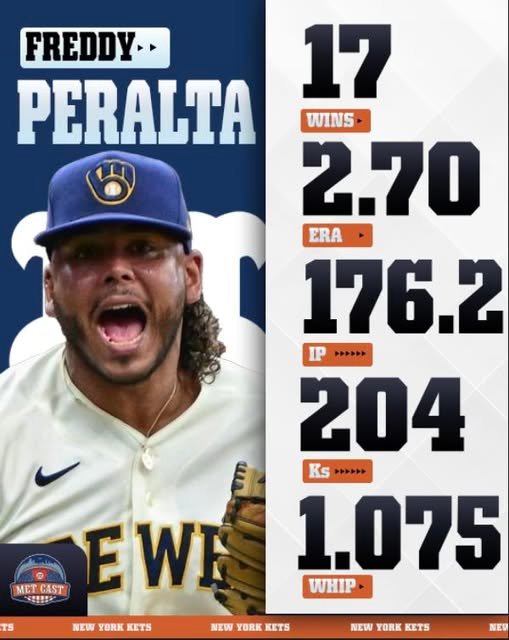
Peralta, 29, arrives in Queens following a career‑best 2025 season in which he led the National League with 17 wins and posted a 2.70 ERA, finishing fifth in Cy Young Award voting. Under contract for $8 million in 2026 with a chance to hit free agency after the season, the right‑hander instantly upgrades the Mets’ rotation and gives them a legitimate ace to lead the staff.
🔍 Who Is Freddy Peralta?
Freddy Peralta debuted in MLB with the Milwaukee Brewers in 2018 and spent eight seasons developing into one of baseball’s most exciting starting pitchers. Over his career, he has compiled a 70–42 record, 3.59 ERA, and more than 1,150 strikeouts, earning All‑Star honors in both 2021 and 2025.
What makes Peralta so intriguing — and valuable — is his electric stuff and high‑upside production. Across his career, he has averaged more than 200 strikeouts in multiple seasons, demonstrating his ability to overpower big league hitters and dominate when he’s on.
🔥 Peralta’s Pitch Arsenal: What Makes Him an Ace
Peralta’s effectiveness isn’t just about results — it’s about how he gets hitters out. His repertoire is built around a high‑velocity fastball and an accomplished secondary pitch mix that keeps batters off‑balance.
At the heart of his arsenal is a four‑seam fastball averaging around 95 mph, which he uses to challenge hitters up in the zone or set up other offerings. Complementing that is an 86 mph slider that accounts for a third of his pitches, darting away from same‑handed hitters and generating weak contact or swings and misses.
While the fastball and slider are his primary go‑to offerings, Peralta also mixes in a changeup, curveball, and cutter to keep hitters guessing. This variety allows him to navigate different lineups and exploit weaknesses, particularly against teams that stack left‑handed batters. His strikeout totals and low WHIP in 2025 reflect this ability to mix pitches effectively throughout starts.
In many ways, Peralta’s approach combines traditional power pitching with a savvy feel for sequencing — a blend that has made him one of the most reliable starters in recent seasons.
📊 What This Means For the Mets’ 2026 Season
The Mets enter 2026 with renewed confidence after narrowly missing the playoffs in 2025. They finished with an 83–79 record, leading the National League East at times but ultimately falling short. Addressing their rotation was a top offseason priority, and adding Peralta gives them a stable, frontline starter who can consistently eat innings and set the tone on the mound.
Peralta’s presence at the top of the rotation should also take pressure off younger arms like Nolan McLean and veterans such as David Peterson and Kodai Senga, creating a rotation that blends experience with upside. With Peralta, the Mets can expect:
- Improved consistency from the rotation
- Stronger performances in high‑leverage divisional games
- Increased chances to compete for an NL East title
Many analysts project the Mets to contend more aggressively in the National League with Peralta leading the pitching staff, pegging them as a sleeper pick to win the division if the rest of the roster stays healthy.
⚾ Comparing Peralta to Other Top Pitching Options
Entering the 2026 offseason, Peralta was one of a handful of high‑impact pitchers available — either through trade or free agency. While his 2026 contract is for one year, the Mets benefit from his strong 2025 performance, which ranked him among the upper tier of MLB starters.
Compared to other top free agents such as established arms like Aaron Nola or Blake Snell, Peralta brings a slightly different profile: one built on strikeout dominance and recent peak performance, even if his overall career consistency hasn’t reached the same longevity as some veterans. Still, his 2025 season places him firmly in the conversation as an impact difference‑maker, especially in the short term.
Where Peralta’s deal differs from longer‑term free‑agent signings is risk — the Mets have just one guaranteed year. If they can extend him beyond 2026, they could keep a true top‑of‑rotation arm in Queens. If not, this trade may go down as a high‑stakes gamble for one playoff push.
🔮 Looking Ahead: Predictions for 2026
If everything clicks, the Mets could surprise many critics and challenge deep into the postseason. Barring injuries, Peralta’s presence should elevate the rotation and provide a stabilizing force the team lacked last year. A reasonable projection sees the Mets finishing near the top of the NL East, with a legitimate shot at both a division crown and a deep playoff run.
Of course, baseball is unpredictable, and much depends on how the rest of the pitching staff performs and whether the Mets can stay healthy throughout the long season. But one thing is clear: signing Freddy Peralta changes the narrative for the Mets in 2026, giving fans and analysts something to be genuinely excited about.
⚾ Peralta’s 2026 Performance Projections: ERA, WHIP & Strikeouts
As the Mets prepare to deploy Freddy Peralta at the front of their rotation, analysts and projection systems have started to estimate what kind of numbers he might put up in 2026 based on his recent track record and career trends.
📊 Expected ERA (Earned Run Average)
While Peralta’s 2025 season was elite — finishing with a 2.70 ERA and leading the National League in wins — projection systems that normalize past results tend to be more conservative. Some models estimate his 2026 ERA to fall closer to the 3.70–4.00 range, which would still be above average for a top‑of‑rotation starter.
Given that Peralta has shown an ability to consistently log innings and control damage in prior seasons, these projections reflect regression toward the mean after a standout campaign rather than a loss of effectiveness.
📈 Expected WHIP (Walks + Hits Per Inning Pitched)
Peralta’s WHIP in 2025 was outstanding — near 1.08, showing his capacity to limit baserunners. Projection models for 2026 typically put his WHIP slightly higher, in the ≈1.15–1.25 range, which would still rank him among the more effective starters in baseball.
This suggests while he might allow a few more baserunners than last year, he’s projected to remain efficient at limiting free passes and hits — key to sustained success over a long season.
🔥 Strikeout Projections
Peralta struck out 204 batters in 2025, a mark well above the Major League average and one that places him among elite pitchers.
For 2026, projections estimate 200–220 strikeouts if he stays healthy and maintains his workload, with expected innings around 170–180. That strikeout volume would keep him near the top of the league and anchor the Mets’ rotation with a reliable swing‑and‑miss pitcher.
Bottom Line: Peralta’s 2026 projections paint a picture of a high‑impact starter, likely with a 3.70–4.00 ERA, 1.15–1.25 WHIP, and about 200+ strikeouts, assuming a full season.
💰 Contract Comparison: How Peralta’s Deal Stacks Up
One of the most talked‑about aspects of New York’s acquisition of Freddy Peralta isn’t just the performance — it’s how cost‑effective his contract is relative to available pitching talent.
🧢 Peralta’s Contract (2026)
- Peralta is under a one‑year, $8 million contract for the 2026 season, with a club option exercised by the Brewers before the trade.
- He will become a free agent after 2026, giving him one year of team control.
This salary is widely regarded as a bargain for a pitcher of his caliber — particularly one coming off a sub‑3.00 ERA season and over 200 strikeouts.
📊 Comparison to Other Top Pitching Contracts
While Peralta’s deal is modest, other marquee pitchers in MLB are earning significantly more — even on shorter deals or in contract years:
- Top free agents/contract arms such as pitchers like Tarik Skubal or Nick Pivetta are (or were) linked to multi‑year contracts with average annual values well above $15M–$20M, reflecting their broader track records and control years.
- For comparison, reliable starters entering contract years often command $15M+ on the open market, and established aces sometimes exceed $30M+ per season in free agency or trade markets.
- Peralta’s $8M figure thus positions him as one of the most cost‑efficient front‑end starters in baseball — particularly given his recent statistical production.
📌 Why His Contract Is Valuable
Peralta’s situation is similar to other “bargain rotation arms” where a strong recent season boosts trade value even in a short contract window. Teams competing now (like the Mets) often favor short‑term controllable value to supplement veteran talent without long‑term financial risk.
Essentially, Peralta’s 2026 contract may rank as one of the strongest value propositions among starting pitchers, especially considering performance projections versus money paid.
🎯 Final Takeaways
Performance Outlook: Peralta’s expected 2026 metrics — a projected ERA in the mid‑3s, WHIP around 1.20, and ~200 strikeouts — indicate a top‑tier rotation piece who can anchor the Mets’ staff.
Contract Value: At roughly $8M, his deal is a phenomenal value compared to typical elite arms, offering the Mets high‑end production without long‑term financial commitment — a luxury many teams would envy.
🏁 Final Thought
The Mets’ acquisition of Freddy Peralta isn’t just a headline — it’s perhaps the most impactful pitching move of their offseason. With his electric arm, polished pitch arsenal, and track record of success, Peralta gives New York a true ace and reshapes the team’s competitive outlook for 2026.
If you’re a Mets fan — or simply a baseball fan tuned into winter moves — this is a story worth watching as Spring Training approaches and the season unfolds.